
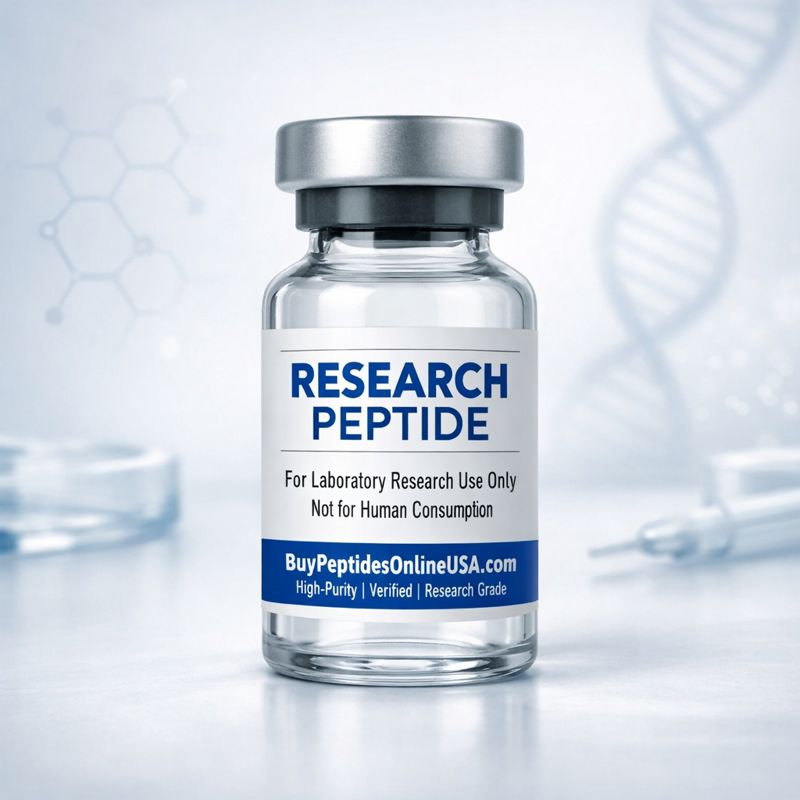
B7-33 Peptide
$55.00
🧬 B7-33 Peptide – Functionally Selective RXFP1 Agonist for Fibrosis & Cardiovascular Research
A synthetic 27-amino acid single-chain relaxin-2 mimetic. Preferentially activates pERK signaling to study anti-fibrotic, cardioprotective, and vasoprotective mechanisms without cAMP-associated side effects. High purity (≥98%). For lab use only. ⚡
Welcome to Buy Peptides Online USA, your premier source for high-purity research compounds designed for serious laboratory investigations. This product is intended strictly for in vitro and in vivo laboratory research use only and is not for human or veterinary consumption.
A New Generation of Relaxin-Based Therapeutics: An Introduction to B7-33 🔬
For researchers focused on the complex pathways of fibrosis, cardiovascular protection, and reproductive health, B7-33 represents a revolutionary advancement in peptide design. This synthetic 27-amino acid peptide is a single-chain mimetic of the naturally occurring hormone human relaxin-2 (H2 relaxin) , which has long been recognized for its potent vasodilatory, anti-fibrotic, and organ-protective properties .
The challenge with native H2 relaxin is its complex two-chain, three-disulfide-bond structure, which makes it difficult to synthesize efficiently and unstable in biological systems . In 2016, researchers developed B7-33 as a minimalist derivative that retains the therapeutic benefits of H2 relaxin while offering enhanced synthetic accessibility and a unique, functionally selective mechanism of action .
What truly distinguishes B7-33 is its functional selectivity at the relaxin family peptide receptor 1 (RXFP1). While native relaxin activates multiple downstream pathways, including cAMP and pERK signaling, B7-33 preferentially activates the pERK1/2 pathway over the cAMP pathway . This biased agonism allows researchers to isolate and study the specific anti-fibrotic and tissue-protective effects of RXFP1 activation while theoretically minimizing side effects associated with broader pathway engagement .
What is B7-33 Peptide?
B7-33 is a synthetic peptide derived from the B-chain of human relaxin-2, consisting of 27 amino acids. Its sequence is H-Val-Ile-Lys-Leu-Ser-Gly-Arg-Glu-Leu-Val-Arg-Ala-Gln-Ile-Ala-Ile-Ser-Gly-Met-Ser-Thr-Trp-Ser-Lys-Arg-Ser-Leu-OH . Its molecular formula is C₁₃₁H₂₂₈N₄₀O₃₇S with a molecular weight of approximately 2987.5 g/mol .
Its primary mechanisms of action are theorized to include:
- Selective RXFP1 Activation: B7-33 binds specifically to RXFP1, the cognate receptor for relaxin-2, which is expressed in the heart, kidneys, lungs, vasculature, and other tissues .
- Biased pERK Signaling: Unlike native relaxin, B7-33 preferentially stimulates the phosphorylation of extracellular signal-regulated kinase 1/2 (pERK1/2) over the cAMP pathway . The pERK pathway is critically involved in cell survival, proliferation, and anti-fibrotic gene expression.
- Anti-Fibrotic Gene Regulation: Through RXFP1 activation, B7-33 promotes the expression of matrix metalloproteinases (MMPs), particularly MMP-2, which degrade excess collagen and extracellular matrix, thereby exerting anti-fibrotic effects .
- Endoplasmic Reticulum (ER) Stress Reduction: B7-33 has been shown to attenuate ER stress in cardiomyocytes by reducing the expression of GRP78, a key ER stress marker, in a pERK-dependent manner .
🔬 Primary Research Focuses and Applications
The B7-33 Peptide is primarily utilized in scientific research to investigate a broad spectrum of physiological and pharmacological questions, supported by robust preclinical data:
- Anti-Fibrotic Research Across Multiple Organs: B7-33 has demonstrated potent anti-fibrotic effects in numerous pre-clinical animal studies . It has been shown to reverse organ fibrosis in models of cardiomyopathy, lung fibrosis, and kidney disease . Its mechanism involves stimulating RXFP1 and promoting the degradation of scar tissue through increased MMP activity . This positions B7-33 as a critical tool for research into conditions like heart failure, pulmonary fibrosis, and chronic kidney disease.
- Cardioprotection and Myocardial Infarction (Heart Attack) Research: A pivotal 2020 study published in the Journal of the American Heart Association investigated B7-33 in a mouse model of cardiac ischemia-reperfusion injury. The results were striking: B7-33 treatment significantly reduced infarct size (21.99% vs. 45.32% in controls) and preserved cardiac function (fractional shortening) at both 24 hours and 7 days post-infarction . In vitro, B7-33 improved cardiomyocyte survival and reduced ER stress markers, demonstrating direct cytoprotective effects .
- Preeclampsia and Pregnancy-Related Hypertension Research: A very recent 2024 study presented at the Journal of Hypertension evaluated B7-33 in two rodent models of preeclampsia (RUPP and DOCA models) . The results demonstrated that B7-33 and its fusion proteins normalized blood pressure, reduced proteinuria, and lowered inflammatory markers (TNF-alpha and sFlt-1) back to levels of normal pregnancy . Researchers concluded that B7-33 is an ideal candidate for development in preeclampsia research .
- Vascular Protection and Endothelial Function: A 2017 study in the European Journal of Pharmacology demonstrated that B7-33 replicates the vasoprotective functions of human relaxin-2 . It has been shown to improve endothelial dysfunction, promote vasodilation, and protect vasculature, making it relevant for research into hypertension, atherosclerosis, and other vascular conditions .
- Acute Heart Failure and Cardiac Remodeling: By reducing left ventricular fibrosis and preserving cardiac function post-infarction, B7-33 is a valuable tool for studying adverse cardiac remodeling and heart failure progression . It has been shown to more rapidly reduce left ventricular fibrosis compared to the ACE inhibitor perindopril in an experimental model of cardiomyopathy .
- Wound Healing and Tissue Regeneration: Like its parent molecule relaxin, B7-33 possesses antioxidant, anti-inflammatory, and wound healing properties . It may be investigated for its ability to improve blood supply, reduce scarring, and promote tissue acceptance of implants .
🧪 Product Specifications & Technical Data
At Buy Peptides Online USA, we ensure your research is built on a foundation of quality and consistency. This peptide is manufactured to rigorous laboratory standards and verified through advanced analytical methods.
| Specification | Details |
|---|---|
| Peptide | B7-33 |
| Sequence | H-Val-Ile-Lys-Leu-Ser-Gly-Arg-Glu-Leu-Val-Arg-Ala-Gln-Ile-Ala-Ile-Ser-Gly-Met-Ser-Thr-Trp-Ser-Lys-Arg-Ser-Leu-OH |
| CAS Number | 1818415-56-3 |
| Molecular Formula | C₁₃₁H₂₂₈N₄₀O₃₇S |
| Molecular Weight | ~2987.5 g/mol |
| Synonyms | (B7-33)H2, B7-33 relaxin, Relaxin B-chain analog |
| Purity | ≥98% (Verified via HPLC and Mass Spectrometry) |
| Quality Verification | Third-party tested for identity and purity (HPLC, MS). Certificate of Analysis (COA) available. |
| Physical Appearance | Sterile, lyophilized white powder |
| Solubility | Soluble in sterile water or bacteriostatic water. TFA salts from purification enhance aqueous solubility . |
| Storage (Lyophilized) | Store at -20°C (-4°F) or below; stable for up to 24 months . |
| Storage (Reconstituted) | Aliquot and store at -20°C for short-term use. Avoid repeated freeze-thaw cycles . |
| Peptide Content | Typically ≥80% (with TFA counterion) . |
| Intended Application | Laboratory Research Use Only (RUO) |
Key Research Findings Summary
B7-33’s effects across diverse research models highlight its utility as a multi-faceted research tool:
| Research Area | Key Finding | Reference |
|---|---|---|
| Myocardial Infarction | Reduced infarct size by ~50%, preserved cardiac function, reduced ER stress in cardiomyocytes . | J Am Heart Assoc. 2020 |
| Preeclampsia | Normalized BP, reduced proteinuria and inflammatory markers (TNF-α, sFlt-1) in two rodent models . | J Hypertens. 2024 |
| Cardiomyopathy | More rapidly reduced left ventricular fibrosis compared to perindopril . | Biomed Pharmacother. 2023 |
| Anti-Fibrotic Action | Reversed organ fibrosis in pre-clinical models of heart, lung, and kidney disease . | Int J Mol Sci. 2023 |
| Vascular Protection | Replicated vasoprotective functions of relaxin-2; improved endothelial function . | Eur J Pharmacol. 2017 |
✅ Why Choose Buy Peptides Online USA for Your Research?
Sourcing reliable research compounds is critical for reproducible, high-impact science. Here is why researchers across the USA trust us:
- Verified Purity & Potency: We provide access to Certificates of Analysis (COA) and rely on advanced analytical methods like High Performance Liquid Chromatography (HPLC) and Mass Spectrometry (MS) to confirm the identity and purity (≥98%) of every batch . This commitment ensures the integrity of your experimental data.
- Research-Focused Integrity: We strictly adhere to research-use-only (RUO) guidelines. Our product descriptions are factual, focusing on chemical properties and cited research applications, never unverified human-use claims . This product is not for diagnostic or therapeutic use.
- Fast & Discreet USA Shipping: We offer fast, reliable shipping across the United States with discreet packaging to ensure your order arrives safely, professionally, and on time for your critical research timelines. Enjoy free shipping on orders over $300.
- Expert Support & Authenticity Guarantee: Our team provides technical consultation to support your work. We stand behind the authenticity and quality of all our products, offering a product replacement service and clear complaint handling.
📝 Handling, Storage, & Important Safety Information
- Critical Storage Information: Upon receipt, store the lyophilized powder at -20°C (-4°F) or below, protected from light and moisture. It is stable for up to 24 months under these conditions .
- Handling for Research Use: This product is for laboratory use only by qualified professionals. Use proper aseptic technique when reconstituting for research models. Follow your institutional animal care and use protocols for all in vivo studies. Allow product to equilibrate to room temperature before opening the vial .
- Stability Considerations: Peptides are typically supplied as trifluoroacetate (TFA) salts from the HPLC purification process, which contributes to total peptide mass but generally enhances solubility . The peptide content is typically >80% of the total weight . Once reconstituted, aliquot and store at -20°C for short-term use. Avoid repeated freeze-thaw cycles, as this can degrade the peptide .
- Safety Considerations: Always wear appropriate personal protective equipment (PPE), including lab coats, safety glasses, and nitrile gloves.
- Warning: This product is not for human or veterinary use. It is not a drug, food, or cosmetic. Not for human consumption or diagnostic use. For laboratory research only .
❓ Frequently Asked Questions (FAQs)
Q: What is the primary mechanism of action for B7-33 in research?
A: B7-33 is a functionally selective agonist of RXFP1 (relaxin receptor). Unlike native relaxin, which activates multiple pathways, B7-33 preferentially stimulates the pERK1/2 pathway over the cAMP pathway . This biased signaling is believed to mediate its potent anti-fibrotic and tissue-protective effects while potentially minimizing other side effects .
Q: How does B7-33 differ from native H2 relaxin (serelaxin) in research applications?
A: Native H2 relaxin is a complex two-chain peptide that is difficult to synthesize and unstable in serum . B7-33 is a single-chain derivative that is much easier to synthesize. More importantly, B7-33 is a biased agonist, preferentially activating the pERK pathway, whereas native relaxin activates both pERK and cAMP . This allows researchers to dissect the specific contributions of these pathways to relaxin’s therapeutic effects.
Q: What have animal studies demonstrated about B7-33’s effects on heart attack?
A: A pivotal study in mice showed that B7-33 treatment after a heart attack (ischemia-reperfusion injury) significantly reduced infarct size by approximately 50% and preserved cardiac function . It protected cardiomyocytes by reducing endoplasmic reticulum (ER) stress, a key driver of cell death .
Q: What is the significance of B7-33 in preeclampsia research?
A: Very recent 2024 research demonstrated that B7-33 normalizes blood pressure, reduces proteinuria, and lowers inflammatory markers in two different rat models of preeclampsia . This suggests it could be a powerful tool for studying this dangerous pregnancy complication.
Q: How do you verify the purity and identity of B7-33?
A: We ensure every batch is rigorously analyzed using High Performance Liquid Chromatography (HPLC) and Mass Spectrometry (MS) . HPLC confirms a purity level of ≥98% , while Mass Spectrometry verifies the precise molecular weight (~2987.5 g/mol), ensuring the correct peptide structure and identity.
Q: What are the critical storage conditions for B7-33?
A: Store the lyophilized powder at -20°C (-4°F) or below, protected from light and moisture . Once reconstituted, aliquot and store at -20°C for short-term use. Avoid repeated freeze-thaw cycles.
Q: Is B7-33 prohibited in sports research?
A: Yes, researchers should be aware that B7-33, as a peptide hormone analog and metabolic modulator, would be included on the World Anti-Doping Agency (WADA) Prohibited List under the general category of hormone and metabolic modulators. It is intended for legitimate scientific research only and not for any applications involving human subjects.
Ready to Advance Your Research? 🚀
Equip your laboratory with a revolutionary, functionally selective tool for studying fibrosis, cardiovascular disease, and reproductive health. Order the high-purity B7-33 Peptide today from Buy Peptides Online USA. Benefit from our fast USA shipping, secure payments (including crypto), and the confidence that comes from rigorously tested research compounds. For any questions about this product or your order, our support team is here to provide technical consultation.
| Analysis Certificate |
COA Available |
|---|---|
| Certifications |
Third-Party Tested ,GMP Manufactured |
| Intended Use |
Research Use Only (RUO) ,For Laboratory Use ,Not for Human Consumption ,Not for Diagnostic Use |
| Purity |
≥98% |
| Shelf Life |
12 months |
| Storage |
Store in a Cool, Dry Place ,Protect from Light ,Refrigerate (2-8°C) |
| Form |
Vials (Injectable, Often Lyophilized Powder or Solution) |
| Primary Function |
Recovery & Healing |
| Functional Sub-Type |
Anti-Fibrotic & Cardioprotective Peptide |
| Quantity |
6mg |
Related products
AICAR Peptide
AOD9604 Peptide
ARA-290 Peptide
Bacteriostatic Water (BAC)
Follistatin 315 Peptide
Follistatin 344 Peptide